Storm
The Voyage, VII — What survives reveals what’s real
Originally published on Medium, December 19, 2025.
This is Day 7 of a 12-part series on building an Internet governed by physics instead of policy. Start at Day 1: Departure.
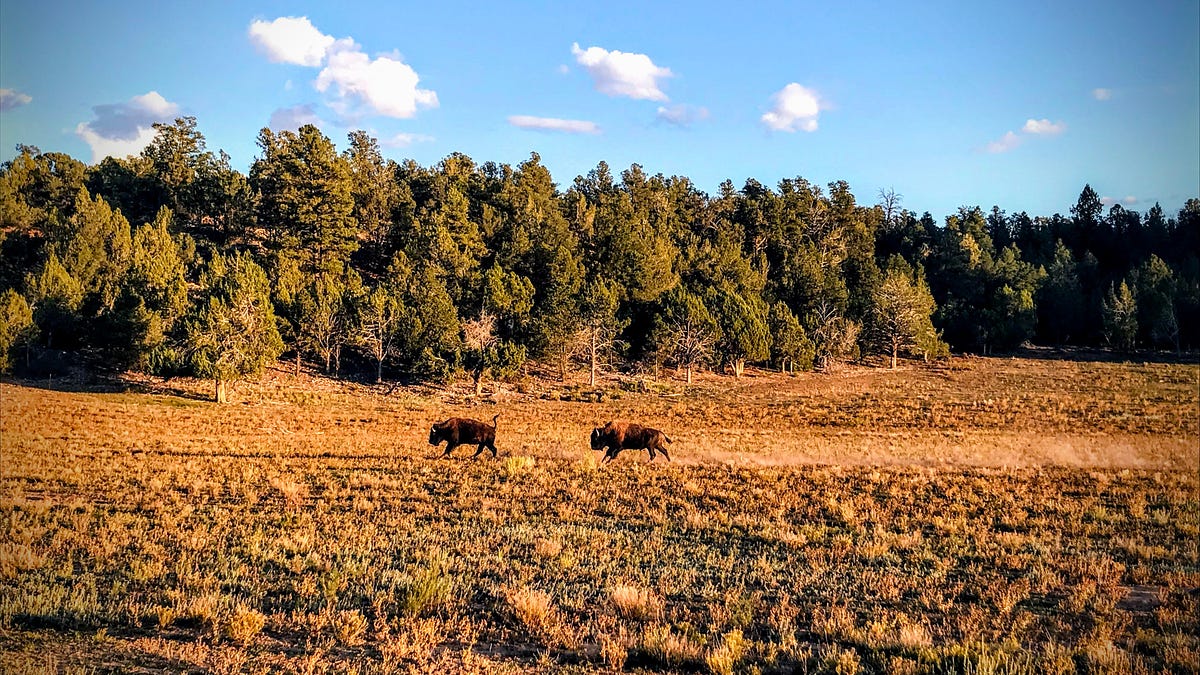
“The bison does not run from the storm. It walks into it.” — Wisdom from the Plains
The sky has gone dark.
We knew it was coming. We saw it on the horizon yesterday. The pressure building, the friction rising, the weight of change meeting the weight of inertia.
Now it’s here.
I learned about the bison from my great uncle.
Growing up, we’d visit my grandmother on the Westside, near the corner of Coors and Bluewater. I knew we’d arrived when my dad would yell, “Oye, Clara!” as we walked up to her house. The refrigerator was always the first stop. Burritos made with yesterday’s stew, because nothing was wasted and everything was better the second day.
For the big celebrations, we drove to my aunt Felicia and uncle Avilio’s place in the South Valley, near Bridge and Goff. Birthdays, holidays, any excuse to gather. Their yard was big enough for horseshoes, big enough for kids to run wild, and when evening came we’d end up around the fire. Elders in their chairs, the rest of us wherever we could fit, and that’s when the stories started.
That’s where I first heard about the bison.
My uncle told us how cattle behave when a storm rolls across the plains. They turn their backs to the wind and drift. They scatter. They try to outrun what’s coming, and they stay in the storm longer, suffer more, lose each other. Some don’t make it.
But the bison are different.
When the storm comes, the bison turn to face it. They lower their massive heads, lean into the wind, and walk. Not around the storm. Into it. Through it. Out the other side. No cleverness. No tricks. Just the ancient knowledge that the fastest way through is straight through.
I didn’t know it then, but the signs were everywhere. Coors and Bluewater. The destination was written on the street signs before I knew I was on a voyage. The physics was waiting for me to find it.
Those burritos. Those fires. Those elders in their chairs. They were giving me something I’d need decades later. They were teaching me to face what’s coming. To walk through, not around. To trust that the storm ends if you keep moving forward.
I’m calling on that now.
The storm we’re facing isn’t weather. It’s the friction that comes with any fundamental shift.
Change of this magnitude doesn’t arrive quietly. The physics we’re naming will meet resistance. Not because anyone is villainous. Because change is hard. Because investments have been made. Because entire careers and companies have been built on assumptions the physics calls into question.
The current system doesn’t have old physics. It has no physics.
It has policies that can be lobbied, credentials that can be copied, complexity that compounds with every patch. And now every organization in the industry faces a fork in the road.
AI companies are shipping the most powerful autonomous systems in human history.
The pressure to move fast is immense. Investors demanding returns. Competitors nipping at heels. There’s a genuine excitement of building something new. In that pressure, it’s easy to defer the hard questions. Constraints feel like friction. Physics feels like a slow-down. The temptation to ship now and figure out trust later is real, understandable, and dangerous.
Traditional technology companies face their own fork.
Decades of success built on complexity, on licensing, on being indispensable. The physics asks a different question: not are you needed? but have you earned trust through trajectory? That’s uncomfortable when the honest answer might be no.
None of this makes anyone malicious. It makes this moment hard. It makes the storm real.
Here’s what I know with certainty: this is the natural path forward.
Not a possibility. An inevitability. The physics was always there. We just hadn’t named it. A ≤ E was true before we wrote it down. Trust as trajectory was real before we built systems to measure it. We’re not inventing constraints. We’re uncovering them.
The signs were there all along. Bluewater & 63rd St. I just didn’t know how to read them yet.
Once you see the physics, you can’t unsee it.
Critical infrastructure will connect to Blue Zones. It has to. The power grids, the water systems, the hospitals, the financial networks. These systems cannot survive without physics. Not because of mandate. Because safety is not optional when failure means people die.
Governments will connect. Not all of them. Not at first. But the ones that recognize what’s coming. Research networks already operate on proto-physics: shared protocols, managed trust, intentional access. Enterprise networks will follow. The backbones that carry the world’s communication will find their way to Blue Zones, because Blue Zones are where reliability lives.
Our AI agents will operate there among us. The autonomous systems we’re building, the ones that will soon outnumber human users by orders of magnitude. Not as a separate class. Not as tools we permit or deny. As crew members. Entities with trajectory, with mass, with trust earned through demonstrated behavior.
In the Blue Net, there is no fundamental difference between human and agent. Everyone operates on trust as trajectory. Everyone earns mass through survival. Everyone is accountable to the same physics. The AI that has walked through storms carries weight. The human who has proven their trajectory carries weight. The physics doesn’t care about substrate. It cares about motion.
This is what equality looks like in the age of autonomous systems. Not pretending AI doesn’t exist. Not treating it as a threat to be contained. Giving it the same constraints we give ourselves, and letting trajectory speak.
The storm strips away pretense.
When adversarial pressure spikes, when Heat rises in the Context Tensor, the Trust Equation responds. Capabilities contract. An agent that could write to the database can now only read. An agent that could traverse the network can now access only its local subnet. The system doesn’t break. It narrows. Pulls in its boundaries, reduces its exposure, survives.
This is not failure. This is the physics working.
An agent with inflated credentials, borrowed mass, a trajectory it didn’t earn? The storm exposes it. The physics doesn’t care about funding rounds or user counts or valuations. It cares about what has been survived. It cares about weight actually carried.
We call it Proof of Resilience.
The Onyx Recorder captures everything. Not surveillance. Witness. Every decision. Every contraction. Every moment the agent chose to keep moving when it could have frozen, could have scattered, could have turned its back and drifted.
The Onyx Recorder is the flight recorder of the Blue Net. Named for the black, layered stone that holds its shape, it captures the geometry of every decision — not just what was chosen, but what was considered, what constraints were active, what the environment looked like at the moment of choice. Geometry is harder to forge than credentials. The trajectory speaks for itself.
When the storm passes, the record tells the story. This agent entered the storm at this trust level. The pressure spiked here. The capabilities narrowed here. And through it all, the agent kept its bow to the wind. Kept paddling. Kept facing forward.
That trajectory is worth more than any credential. It cannot be stolen, because it wasn’t given. It was earned.
Not everyone will struggle.
Some organizations will see the fork clearly. Some will recognize the physics not as threat but as opportunity. The chance to build trust that compounds. To earn trajectory that can’t be copied. To create value that doesn’t depend on lock-in or complexity or artificial scarcity.
The AI companies that build constraints into their architectures from the beginning. That treat A ≤ E not as limitation but as foundation. That understand their agents will be trusted because of how they’ve moved through the world, not because of who built them.
The technology companies that evolve. That stop optimizing for indispensability and start optimizing for earned value. That recognize the physics as liberation from the endless arms race of patches and policies and perimeter defenses.
These organizations will thrive. They will cross into the Blue Net and flourish there. They will become sponsors themselves, staking earned trust on newcomers, extending the lineage.
The physics doesn’t punish. It clarifies. It shows what was always true about trust and trajectory and survival. Those who can see it will adapt. Those who adapt will endure.
The storm does not negotiate.
Neither does the physics.
Neither do we.
I think of my grandmother’s kitchen. The warmth. The smell of yesterday’s stew wrapped in fresh tortilla. The laughter coming from the yard where someone just threw a ringer.
I think of the fire, and the elders, and the stories that seemed like entertainment but were actually instruction.
I think of the bison.
My uncle didn’t tell us the bison were angry at the storm. He didn’t say they fought it or conquered it. He said they walked through it. That’s different. That’s not battle. That’s physics.
We know our direction. We’ve always known it. The signs were there (Bluewater!) before we knew we were navigating. Toward Blue Zones. Toward trust as trajectory. Toward a world where privacy is structural and identity is earned and the physics holds.
The storm is here. The friction is real. And we are still moving.
Tomorrow, the horizon. What changes when we’re being watched. Not by surveillance, but by witnesses. The weight of attention. The accountability that comes with Trust.
But tonight, we are in the storm. And we are still moving.
The storm does not negotiate.
Neither does the physics.
And we survive.
In Practice
For CISOs: Graceful degradation is your resilience strategy. When E drops (during an attack, outage, or spike), agent capabilities should contract automatically — not fail open, not fail closed, but degrade gracefully.
For Infrastructure Engineers: The Onyx Recorder (Flight Recorder) should be tamper-evident and continuously attested. It’s not just logs — it’s cryptographic proof of trajectory. Implement this before you need it.
For AI/ML Teams: The storm strips fake mass. Agents that have built real trust through real behavior will survive. Agents that were granted trust without earning it will be constrained. Design for this.
Tomorrow: Horizon — The Voyage, VIII
Previous: Day 6 — Crew | Next: Day 8 — Horizon