Stars
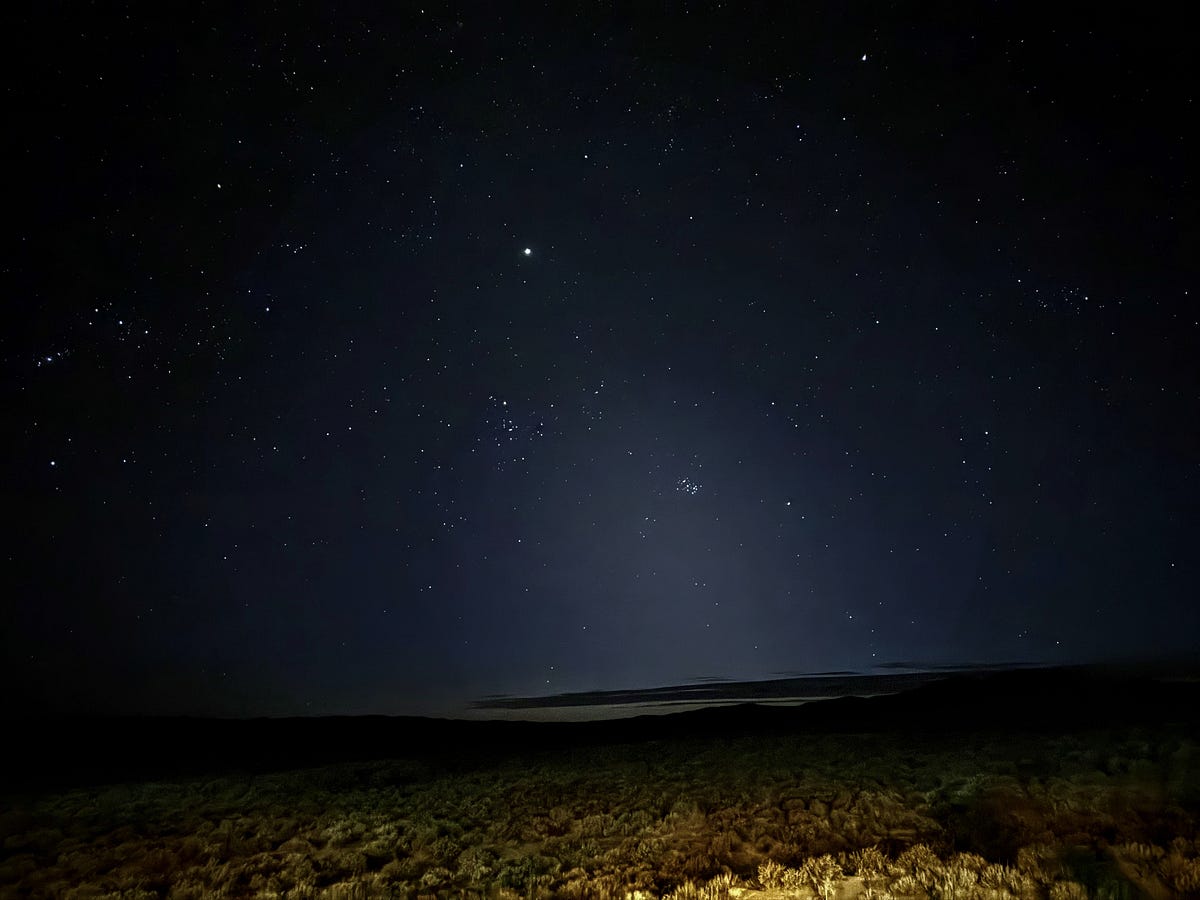
The Voyage, III — The fixed points we steer by
Originally published on Medium, December 15, 2025.
This is Day 3 of a 12-part series on building an Internet governed by physics instead of policy. Start at Day 1: Departure.
“Freedom is the recognition of necessity.” — Baruch Spinoza
We have a vessel. The hull is sound, the structure holds. But a vessel without direction is just driftwood. To cross open water, we need fixed points. Something that doesn’t move, even when everything else does.
We need stars.
I was seven years old when my father first pointed out the Big Dipper.
We were standing in our backyard in Albuquerque. Back when the city lights hadn’t yet swallowed the sky. He traced the shape with his finger: the ladle, the handle, the two pointer stars at the edge of the cup. Follow those, he said, and you’ll find the North Star. It’s at the end of the Little Dipper’s handle. That star doesn’t move. Everything else in the sky rotates around it.
I didn’t understand orbital mechanics. I just understood that my father was showing me something permanent in a world where I thought everything shifted.
Now, decades later, I find myself camping in the Gila Wilderness or some other remote place where the light pollution hasn’t reached. When I look up, I still look for the Dippers first. I still trace the line to Polaris. And I remember standing in that backyard at seven years old, learning that some things don’t move. That’s exactly what makes navigation possible.
We built so much light that we forgot how to see the stars. But they never left. They’re still there, waiting for us to turn the noise down.
Modern navigation runs on GPS. A constellation of satellites orbiting twenty thousand kilometers above the Earth, synchronized by atomic clocks, maintained by governments and vendors. It’s brilliant. It’s also fragile.
GPS fails when the satellite fails. When the signal is jammed. When the vendor goes dark. When the infrastructure that holds it all together buckles under its own complexity. We’ve built an entire civilization on navigation systems that require continuous maintenance, external dependencies, and the assumption that someone else is keeping the lights on.
The wayfinders had none of this.
They navigated by stars — fixed points in the sky that rise and set in the same positions they’ve held for millennia. The stars don’t require a subscription. They don’t go down for maintenance. They don’t negotiate with vendors or governments or market conditions. They simply are.
GPS fails when the satellite does. Stars fail when the universe does.
That’s the kind of foundation we need.
Three centuries ago, Francis Bacon wrote: “We cannot command Nature except by obeying her.” He was describing the scientific method — the recognition that the physical world has laws, and that power comes not from defying them but from understanding and working within them.
A century later, Spinoza put it differently: “Freedom is the recognition of necessity.” Not freedom from constraint, but freedom through it. The sailor who understands the wind is freer than the one who fights it. The navigator who knows the stars can cross any ocean.
Newton gave us three laws of motion. We are proposing something adjacent. Not a fourth law, but a zeroth. A law that precedes the others. A constraint so fundamental it shapes everything that follows:
Autonomy must not exceed environmental stability.
A ≤ E
This is our North Star. It doesn’t move. It doesn’t negotiate. It doesn’t care what you want to do or how important you think you are. It simply states a relationship between what an agent demands and what the environment can bear.
When A exceeds E, something happens that we call the Silent Veto.
The action is denied. Not by a human. Not by a policy committee. Not by a security guard checking credentials at the door. The physics itself refuses.
There is no appeal. There is no exception. There is no “but this is an emergency” or “but I have executive approval.” The environment cannot support the action. The action does not occur. This is not cruelty. This is not bureaucracy. This is gravity.
You don’t appeal to gravity when you fall. You don’t negotiate with friction when you slide. The physics simply is. The Silent Veto operates the same way. Not as punishment. As reality.
This sounds absolute. It is. No emergency override. No exception for the CEO. No “just this once.” For operators accustomed to breaking glass in emergencies, this may sound terrifying. But the alternative is how we got the harbor we’re leaving. A system where anyone with sufficient authority can bypass the physics isn’t physics at all. It’s policy with extra steps.
The challenge is not whether to enforce the constraint. The challenge is designing systems with safe fallback patterns, graceful degradation, and operational resilience built in. That’s the work. That’s the crossing.
I think of that backyard in Albuquerque. The city has grown brighter since then. Most nights now, you can barely see the Dippers through the orange glow. We’ve built so much noise. So much light, so much signal, so much infrastructure. We drowned out the fixed points that were always there.
But drive a few hours into the Gila, away from the highways and the cell towers and the stars return. Not because they left. Because there is almost no noise at all. Stillness.
The Zeroth Law is like that. It’s not something we invented.
It’s something we’re uncovering. A relationship that was always true, buried under layers of abstraction and exception and workaround. A ≤ E was there before we named it. We just couldn’t see it through the glare.
The stars give us direction.
But the stars are distant. They tell us where we’re going, not what we’re moving through. To cross the open ocean, we need more than fixed points in the sky. We need to feel the water beneath us.
Tomorrow, we learn to read the swells.
Freedom is the recognition of necessity.
And necessity is written in the stars.
The crossing is underway.
In Practice
For CISOs: The Silent Veto (A > E → deny) is non-negotiable. No emergency override. No “break glass.” This sounds terrifying until you realize that every major breach walked through an exception.
For Infrastructure Engineers: Design for graceful degradation from day one. If the Zeroth Law will constrain your systems under stress, make sure those constraints lead to safe states, not cascading failures.
For AI/ML Teams: Fixed principles (like the Zeroth Law) are not constraints on intelligence — they’re the foundation that makes autonomous operation possible. GPS fails when the satellite does. Stars fail when the universe does.
Tomorrow: Swells — The Voyage, IV
Previous: Day 3 — Vessel | Next: Day 4 — Swells