Horizon
The Voyage, VIII — The weight of witnesses
Originally published on Medium, December 20, 2025.
This is Day 8 of a 12-part series on building an Internet governed by physics instead of policy. Start at Day 1: Departure.
“It is the theory that decides what we can observe.” — Albert Einstein
The storm has passed.
We are battered but not broken. The vessel held. The crew held. The physics… still there. And now, through the clearing air, we see it for the first time.
The horizon.
There’s a moment in every crossing when land becomes possible. Not visible yet. Not certain. But possible. The quality of the light changes. The birds appear. The swells shift in ways that suggest something solid ahead, something that interrupts the endless water, the chaotic complexity.
The wayfinders knew this moment. They called it deep seeing. Not seeing with eyes alone, but with everything. Reading the signs that meant the crossing was almost complete.
We are in that moment now. The horizon is ahead. And everything changes when you can see where you’re going.
Everything changes, too, when others can see you.
I was born in Albuquerque. Nearly the middle of New Mexico. The intersection of I-40 and I-25. East and West. North and South. A crossroads.
Growing up at a crossroads teaches you something about perspective. Everything passes through. Everything connects. And above it all, the sky.
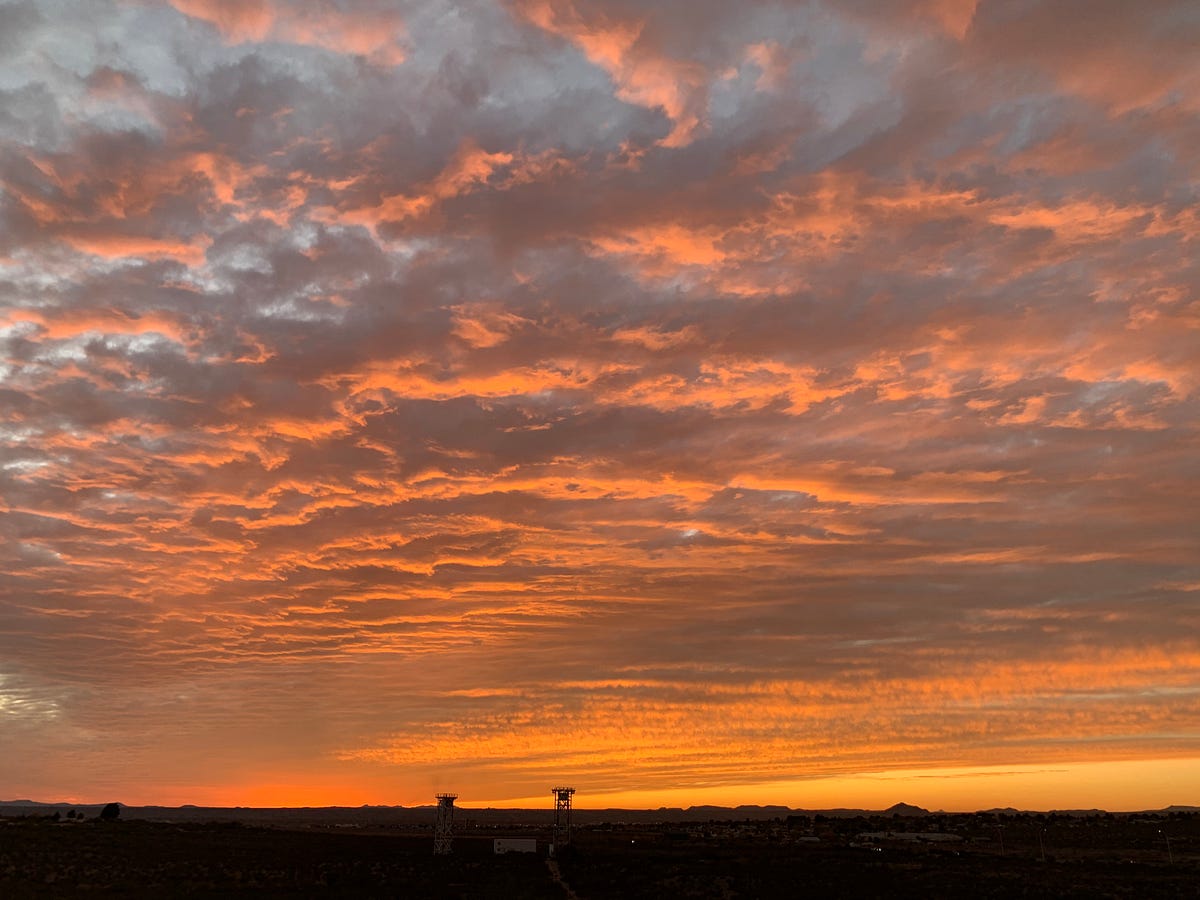
The big sky.
If you’ve never been to New Mexico, it’s hard to explain.
The sky here isn’t a ceiling. It’s a presence. It stretches so wide and so far that you can see weather happening fifty miles away. You can watch a storm roll in from the North while the sun still blazes over the West Mesa, turning the Sandias into something you don’t have words for, only silence. The land is vast, but the sky is vaster.
And the sky… the sky sees everything.
I’ve spent a lot of time being witnessed by the sky.
Camping in the Pecos, where the ponderosas give way to alpine meadows and the only sounds are wind through the trees higher up the mountain side. Sitting at the edge of White Sands at sunset, watching the gypsum turn gold, then pink, then purple, the dunes stretching to the horizon like frozen waves. Walking the acequias in the Bosque along the Rio Grande, cottonwoods towering overhead, the brown water sliding south the way it has since the mountains rose.
Standing on the Gorge Bridge near Taos, looking down at the Rio Grande carving its way through ancient rock, 650 feet below. The scale of it silences you. You are small. The land is old. And something is watching.
Camping in the Jicarilla country up north, where the high desert meets the mountains and the stars at night are so thick you forget there’s supposed to be darkness between them. Wandering through the markets on Santa Fe’s Plaza, adobe walls holding centuries of history, the Sangre de Cristos rising behind the cathedral.
Every place different. Every place connected by the same sky.
And in every place, the same feeling: I am being witnessed. Not by people. By the land itself. By something larger than me that doesn’t care about my credentials or these articles, or my plans. Something that simply sees. Something that holds the truth of what I do, whether or not I want it held.
That’s what witnessing means.
Einstein understood something profound about observation. In physics, the act of measuring changes what is measured. The observer is never separate from the system. Attention has weight.
We’ve built the same truth into the physics we’re naming.
The sixth dimension of the Context Tensor is the Observer. It measures who is watching. VIP presence. Regulatory jurisdiction. Public scrutiny. Audit mode. The frame of reference matters because the frame of reference changes behavior.
This isn’t surveillance. Surveillance watches to catch wrongdoing. This is different. This is witnessing to enable right action.
When the Observer score rises, when attention increases, agents behave differently. Not because they’re controlled. Because they’re seen. The physics of attention creates its own constraint. Its own gravity.
Think about standing on the Gorge Bridge. The land doesn’t judge you. The canyon doesn’t punish you. But you stand differently there. You breathe differently. The scale of what’s watching changes what you prioritize.
The Observer dimension works the same way. When regulatory scrutiny increases, when a VIP enters the environment, when the system knows it’s being witnessed, capabilities adjust. Not punishment. Awareness. The weight of witnesses.
But witnessing only works if there’s something to witness.
In the old system, we had logs. Timestamps. Records that showed what happened, maybe, if the logging was configured correctly, if the storage didn’t fill up, if no one deleted the evidence.
Logs can be altered. Logs can be incomplete. Logs tell you what someone wanted you to know, not necessarily what actually happened.
We’re building something different. We call it the Onyx Recorder, but the name matters less than the principle.
Every decision an agent makes leaves geometry. Not just a log entry. A shape. A trajectory through decision-space that shows not only what was chosen but what was considered. What was rejected. What constraints were active. What the environment looked like at the moment of choice.
Geometry is much harder to fake than credentials. A password can be stolen in seconds. A trajectory takes time to build — and if the Flight Recorder is attested and tamper-evident, that geometry becomes nearly impossible to forge. The Onyx Recorder doesn’t just log events. It creates a cryptographic record of the agent’s path through state space. You can fake a credential. You cannot fake having been there.
The land works this way. The Rio Grande has carved the gorge for millions of years. That carving is a trajectory. You can’t fake it. You can’t claim the canyon was made by something else. The geometry tells the truth.
We’re building systems that tell the truth the same way.
This is accountability without surveillance.
We’re not watching users. We’re witnessing systems. We’re not recording what people do. We’re recording how agents move through constrained space.
The difference matters.
Surveillance assumes guilt. It watches because it expects wrongdoing. It creates adversarial relationships between the watcher and the watched.
Witnessing assumes physics. It observes because observation is part of the system. It creates accountability through visibility, not through suspicion.
The New Mexico sky doesn’t assume I’m guilty of anything. It simply sees. And because it sees, I move differently beneath it. More honestly. More aware that the truth of my motion is being held somewhere, by something, whether or not I acknowledge it.
The Flight Recorder on an airplane doesn’t exist to catch pilots doing wrong. It exists to understand what happened. To learn. To improve. To honor the truth of the trajectory even when that truth is difficult.
The Onyx Recorder works the same way. When something goes wrong, we don’t search through logs hoping to reconstruct events. We examine the geometry. The shape of decisions is preserved. The trajectory speaks for itself.
And when something goes right? The geometry shows that too. An agent that navigated a storm, that contracted gracefully under pressure, that kept its bow to the wind through adversity? That trajectory is recorded. That Proof of Resilience becomes part of the agent’s mass. The witnessing validates the survival.
There’s a deeper truth here about what it means to be accountable.
In a system without physics, accountability is punishment after the fact. Something goes wrong, we find someone to blame, we apply consequences. The accountability is not only subjective, it is retrospective and usually adversarial.
In a system with physics, accountability is continuous and structural. Every decision happens within constraints. Every action leaves geometry. The accountability isn’t something imposed later. It’s woven into the fabric of motion itself.
You cannot move without leaving a trajectory. You cannot act without the environment responding. You cannot exceed A > E without the Silent Veto engaging. The accountability is immediate, constant, and impersonal.
This is not dystopia. This is physics.
Gravity doesn’t punish you for falling. It describes the relationship between mass and motion. The accountability we’re building works the same way. It doesn’t punish agents for failing. It describes the relationship between autonomy and environment. It makes the constraints visible. It lets the trajectory speak.
We are approaching the horizon now. The crossing is almost complete.
And we approach it witnessed. Every storm we weathered is recorded. Every contraction, every adaptation, every moment we kept moving when we could have drifted. The geometry of our decisions precedes us.
This is what we carry to the new shore. Not credentials that can be stolen. Not reputation that can be manufactured. Trajectory. The shape of how we moved through the world. The weight of what we survived.
I think of the big sky over New Mexico. How it holds everything. The Pecos and the Bosque. The white sands and the gorge. The crossroads where I was born and the markets where history still trades hands.
The sky doesn’t judge. It witnesses. And in that witnessing, everything finds its true shape.
In practice, this means: as the Observer dimension increases — as more eyes are on the system, as more witnesses are present — an agent’s effective capabilities tighten. The action that was permitted when no one was watching becomes constrained when the light of attention falls. Not because someone decided it should be, but because the physics of the system demands it. High Observer pressure means high accountability, which means lower effective autonomy.
Tomorrow is the solstice. The longest night. The moment when the sun stands still before beginning its return.
Tomorrow, we reach the sacred. What cannot be overridden. The boundaries that exist not because of policy but because of reverence. The seventh dimension. The fire that does not yield.
But today, we stand at the horizon. Witnessed. Accountable. Seen.
It is the theory that decides what we can observe.
And we have built a theory worth observing.
We are witnessed.
In Practice
For CISOs: The Observer dimension (O) means accountability without surveillance. As more witnesses are present (auditors, monitors, peer systems), agent capabilities tighten. This is not a bug — it’s how trust scales.
For Infrastructure Engineers: Implement Observer as a dimension in your Context Tensor. High O means high accountability, which means lower effective autonomy. Make this relationship explicit in your authorization logic.
For AI/ML Teams: Your agents should behave differently when they’re being watched. Not because they’re hiding something, but because accountability changes the risk profile. Build this into their decision-making.
Tomorrow: Sacred — The Voyage, IX
Previous: Day 7 — Storm | Next: Day 9 — Sacred