Wolfram.
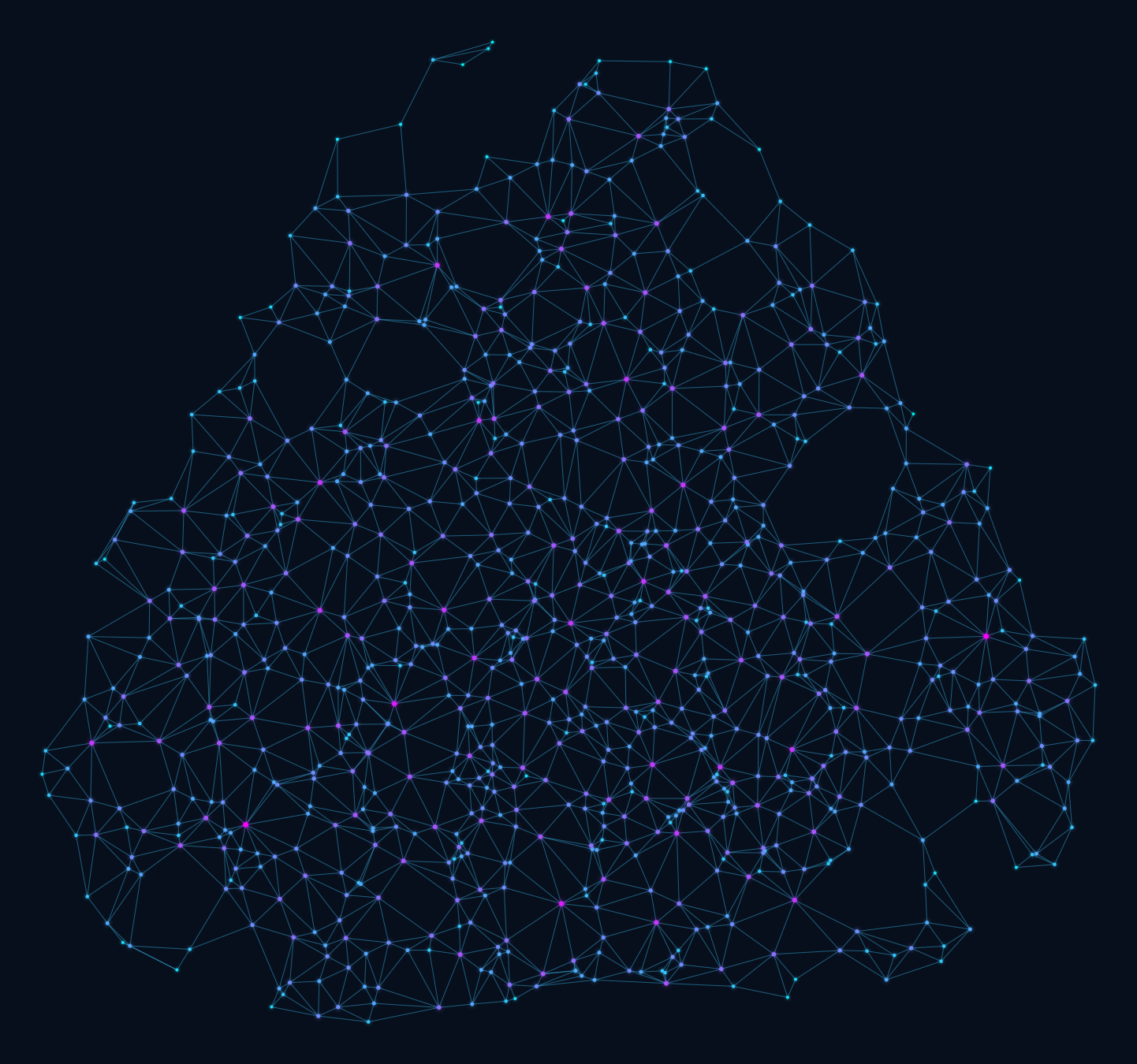
A salute. Stephen Wolfram spent decades turning a computer at the sky like a telescope and reporting what he saw: that simple rules, run long enough, produce behavior no shortcut can outrun. He named the thing — computational irreducibility — and followed it down to the ruliad, the entangled limit of all possible computation.
This is not a citation of convenience. The Kinetic Trust Protocol stands on his floor. We don't cite Wolfram for support. We build on him. This page shows the floor, then shows what we build on it.
A simple rule, and no way around it
Below is Rule 30 — one of the 256 simplest programs there are. A row of cells, each black or white. To draw the next line, look at every cell and its two neighbors on the line above, and set the color from a fixed eight-entry table. That is the entire program. Start it from a single black cell and it produces this.
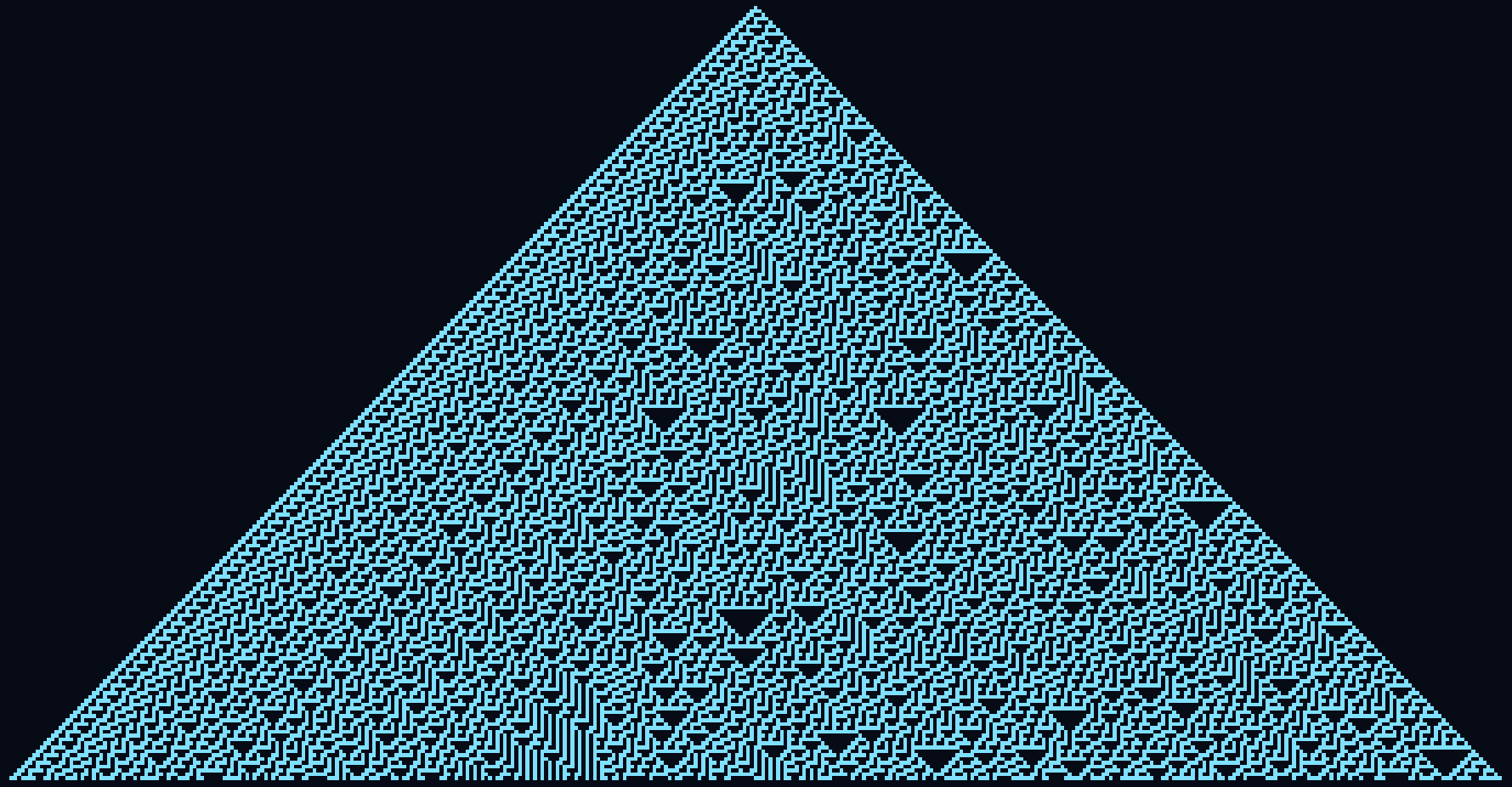
Look at the center column. It is, for every test anyone has run, random. There is no formula that jumps ahead of it. To learn the ten-thousandth cell, you must compute ten thousand steps. That is computational irreducibility — and Wolfram argues it is not a failure of cleverness but a limit on what any observer inside the system can do, a cousin of Gödel's theorem. Science can describe the rule perfectly and still be unable to tell you what the rule will do.
You cannot read the rule and know what it does
Here are four of those 256 rules, each grown from a single cell.
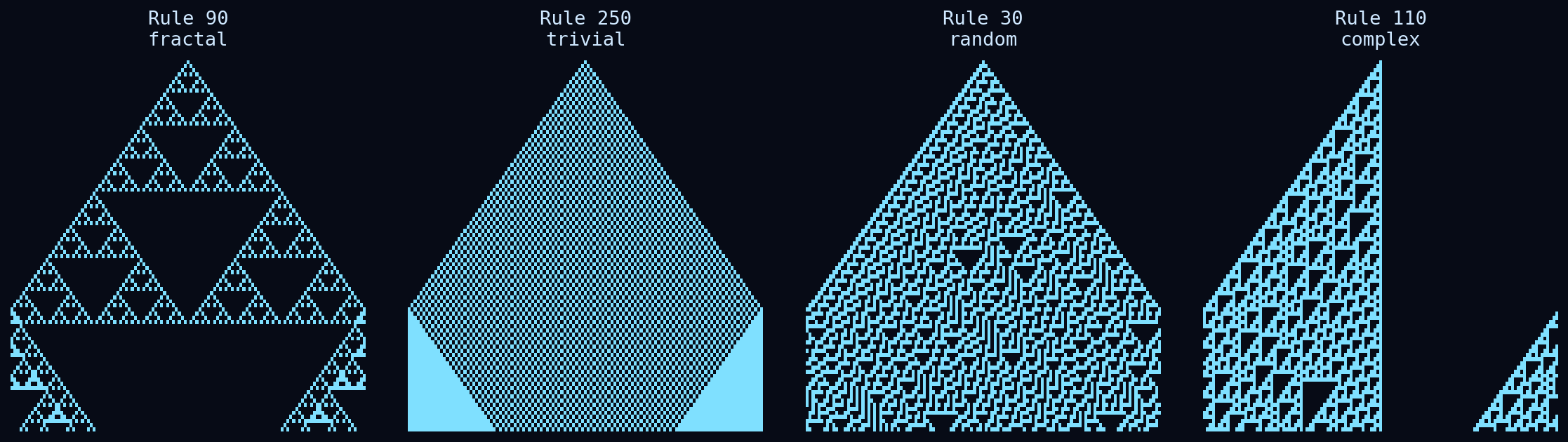
Rule 90 draws a perfect fractal — you can write a closed form for it. Rule 250 is trivial. Rule 30 is noise. Rule 110 builds structures elaborate enough to carry out any computation at all. The unsettling part is the one that matters here: nothing in the rule tells you which world you are in. You cannot look at the rule and know whether its output will be a formula or a wall of noise. You have to run it and watch.
Now make the program an AI agent — a system vastly larger than eight table entries, making deep use of computation. The same limit applies, and it bites harder, not softer. You cannot read the weights and predict whether the agent will do the wrong thing any more than you can read “Rule 30” and predict its center column. Inspection does not scale into a guarantee. A test samples the pockets you happened to check. This is why alignment-by-prediction fails in principle, not merely in practice — and why the protocol does not try to certify the agent's disposition. It constrains the agent's environment instead: bound what any action can do, regardless of what the agent computes. That is A ≤ E, the Zeroth Law. When the ceiling would be crossed, the action isn't denied — it becomes impossible. The Silent Veto.
There is a gift hidden in the same theorem. Irreducibility is never total: inside it there are always pockets of reducibility — the fractal in Rule 90, the columns you genuinely can predict. Those pockets are exactly the part you can govern. So the protocol does the only sane thing: it governs what it can predict and bounds the rest. Wolfram supplies the shape of the problem; A ≤ E is what you build on it.
The ruliad, and the observer inside it
Push the same idea to the foundations. Space, in Wolfram's models, stops being a smooth backdrop and becomes a network of discrete “atoms of space” being rewritten step by step — whenever a small piece of the network looks like this, replace it with that. Run the rewriting and, in the aggregate, general relativity falls out; let the pieces be rewritten in every possible order and quantum mechanics falls out. Keep going and every possible rule, applied every possible way, collapses into a single object — the ruliad, the entangled limit of all computation. Given the idea of computation at all, Wolfram argues, the ruliad is not a choice; it simply, necessarily, is.
The surprise is what that says about us. We perceive the particular laws of physics we do, Wolfram claims, because of what kind of observer we are — and we have two defining traits: we are computationally bounded (finite minds, unable to run the irreducible computation ourselves) and we believe we persist through time (a single thread of experience, even though the atoms of space that make us are different at every moment). The second law of thermodynamics, in this telling, is not a fact about molecules — it is a fact about bounded observers who cannot un-scramble what the world has computed. Without an observer with definite characteristics, there is nothing particular to say.
That last move rhymes with something the protocol already holds — that a witness with a definite position is what turns raw activity into something you can make claims about. A resonance worth naming, and no more than that.
Three maps
Small diagrams of where these ideas sit relative to the protocol. Drag, or read the plain-text inventory beneath each — the canvas is decoration, the relations are the point.
Computational irreducibility is the floor under the protocol's oldest claim: you cannot certify a deep-computation agent from the inside. Undecidability, the impossibility of a complete finite guardrail set, and the impossibility of self-certification are the same limit wearing different clothes. Once prediction is off the table, the only lever left is the environment — A ≤ E — enforced, not argued.
Independent projects keep arriving at the protocol's conclusions — a civilization-scale architecture, a large-audience science explainer, a commercial governance stack. They are witnesses. Wolfram is not among them: he is the ground they all stand on. Each assumes you cannot guarantee the agent; computational irreducibility is why.
The ruliad was already part of the framework's cosmology before this page existed — sitting beside the Fold, Lovelace's question, the circle in π, and the physics of trust. It is not a bolt-on citation; it is terrain the program has been standing on for a while.
Wolfram states the problem; A ≤ E is the answer
He says it plainly: “as soon as you build an AI that makes deep use of computation, it has computational irreducibility… you can never say, I know you're never going to do the wrong thing.” That sentence is the protocol's whole premise, arrived at from the physics of computation rather than from security practice. If you cannot predict the agent from its rules, no finite set of guardrails closes and no system certifies itself from the inside. The move Wolfram names but does not make — from can't guarantee to therefore constrain the environment — is A ≤ E.
One more bridge is worth having in his own frame. Wolfram describes biological evolution and machine learning as the same trick: both work by fitting together “random lumps of irreducible computation” — rocks that happen to interlock — rather than by engineering clean parts. That is the protocol's insistence that the interesting behavior is grown in the substrate, not designed into the weights, said from the other side of the field.
Keep the scope honest. Irreducibility is epistemic — it is a statement about prediction. A ≤ E is a mechanism — it is a statement about enforcement. Wolfram gives you the floor; he does not give you the building. The protocol is the building.
Is intelligence special, or isn't it?
The bridge has a fault line, and we do not paper over it. Wolfram deflates intelligence: his principle of computational equivalence holds that the weather computes as sophisticatedly as a brain — intelligence is not a special kind of computation. The Physics of Intelligence, and popular accounts like it, do the opposite: they treat intelligence as a distinct, uniquely fungible substrate. Both cannot be simply true.
If computational equivalence is right, then “intelligence as substrate” is really a claim about alignment with the pockets of reducibility that human minds can use — not about intelligence being a different species of computation. We hold that disagreement open rather than settle it by assertion. It is the most load-bearing tension on this page, and the honest reason to keep reading Wolfram adversarially even while standing on him.
This page discusses and cites Stephen Wolfram's A New Kind of Science and the Wolfram Physics Project as primary sources (wolframscience.com). Every image here — the ruliad mesh and the cellular automata — is our own generation, computed from the rules; no Wolfram or NKS Explorer image is reproduced. Nothing here implies Wolfram's endorsement of the Kinetic Trust Protocol or of this reading.